
The S‑100 Data Management System supports compliant S‑57 and S‑100 workflows, validation, authentication, and publication for hydrographic data producers.

The S‑100 Data Management System (SDMS) is a modular, workflow‑driven solution designed to help organizations efficiently manage, validate, and prepare S‑57 and S‑100 data products. Built to align strictly with IHO standards, SDMS supports consistent, auditable data management across multi‑user production environments.
SDMS enables hydrographic offices and data producers to move confidently from edited datasets to authenticated, standards‑compliant exchange sets, supporting both current S‑57 operations and the transition to S‑100.
SDMS is designed around predefined, status‑driven workflows that reflect the dependencies and validation requirements defined within S‑57 and S‑100 standards. This ensures data management processes remain consistent, repeatable, and compliant, while still allowing flexibility to meet organizational requirements.
The system focuses on post‑editing data management, bridging the gap between data creation and final distribution.

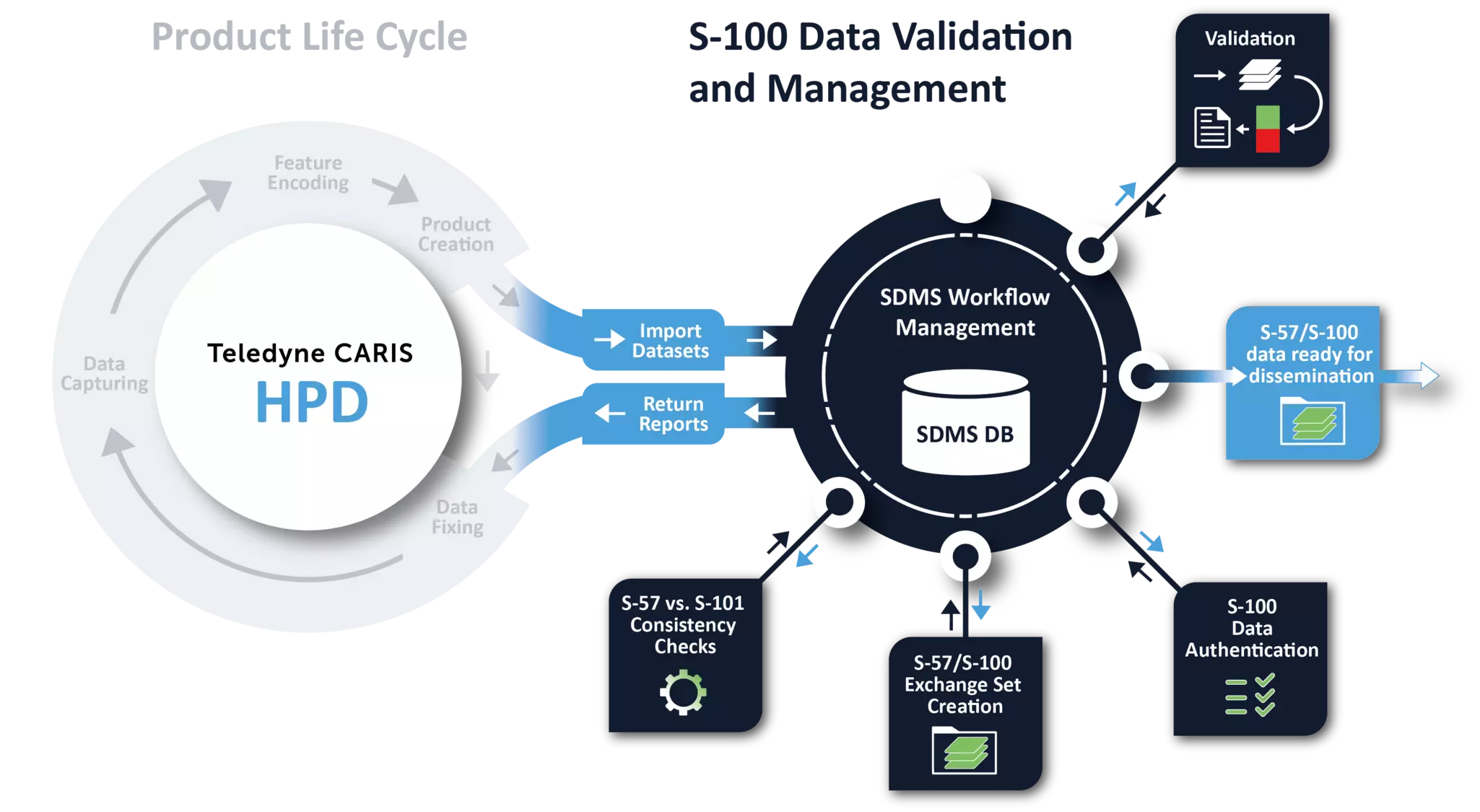
SDMS integrates with HPD and Caris Composers (S-57, S-100). This integration enables a streamlined workflow for S-57/S-100 data processing and quality control:
This joint solution enhances efficiency, ensures data integrity, and supports compliance with IHO S-57 and S-100 data standards.
Image: Interaction of S-100 Data Management System and 7Cs Analyzer
Contact Sales
SDMS supports a wide range of S‑100 specific processes designed to prepare datasets for secure exchange and distribution.
SDMS supports management, storage, and processing of the following product types:
This ensures continuity for organizations managing mixed portfolios during the transition from S‑57 to S‑100.
By combining structured workflows, integrated validation, and modular scalability, SDMS helps organizations reduce operational risk while preparing for long‑term S‑100 adoption. With seamless integration with CARIS HPD - Its standards‑first design supports consistent production outcomes across distributed teams and evolving regulatory requirements.

Streamline hydrographic data management with CARIS HPD. Utilize an integrated suite of applications for efficient, simultaneous data processing and product creation, supporting S-57, S-101, and S-100 standards.

Create and maintain IHO S-57 Electronic Navigational Charts (ENC) with CARIS S-57 Composer. Benefit from intuitive workflows, robust quality assurance, and support for S-100 standards.

Create and manage S-100 products, including S-101 ENCs, with CARIS S-100 Composer. Enjoy seamless integration with S-57 production and robust tools for efficient, compliant chart creation.

Validate S-57 and S-100 nautical chart datasets with confidence. 7Cs Analyzer delivers comprehensive compliance checking against the latest IHO standards.

